……BILLY SUTER……
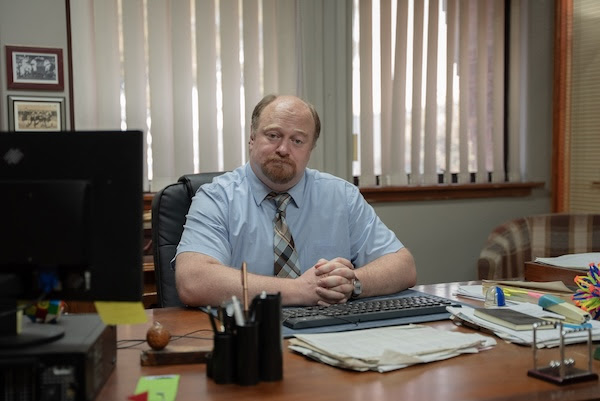
IN THE original British series of The Office, Ricky Gervais played David Brent, a middle-manager at a paper factory in Berkshire. In the US version, Steve Carell played Michael Scott. Now in the South African reimagining of this hilarious comedy series – which starts on Showmax on Tuesday, January 20 – we have Albert Pretorius as Flip, manager at a polony factory.
Presented in Afrikaans in South Africa, as Die Kantoor, the show’s trailer can be seen here: https://youtu.be/AxqOPT45LDA
The trailer gives South Africans their first taste of 2025 Fleur du Cap and Woordfees winner Albert Pretorius (Niggies; Nêrens, Noord-Kaap) as Flip, the manager at polony distributors Deluxe Processed Meats.
Rapid Blue, part of BBC Studios, is producing the Showmax Original, with Safta and Silwerskerm winner Bennie Fourie (Hotel) as the head writer and director. BBC Studios is handling global sales.
In addition to Pretorius, the cast includes Schalk Bezuidenhout (Kanarie, Hotel), screen legend Lida Botha (Die Kwiksilvers), Carl Beukes (Jozi, The Shakedown), Ilse Oppelt (Oh Schuks I’m Gatvol, Fishy Fêshuns), Daniah de Villiers (Mia in Mia and the White Lion), Mehboob Bawa (Bhai in Bhai’s Cafe), former KFM presenter and newcomer Gert du Plessis.
Showmax caught up with actor Albert Pretorius to find out more about his biggest TV role yet:
The manager is an iconic role that earned both Ricky Gervais and Steve Carell their first Golden Globes, as David Brent in the British version and Michael Scott in the US version, respectively. Did you feel the pressure?
Yes, it’s a scary one; this is one of the dream ones. Very few people ever get to play a role this big.
Tell us about Flip.
Flip thinks of himself as the Rassie Erasmus of polony; in his mind, the documentary crew is making his Chasing the Sun, about how he’s taking this team to the next level.
He grew up watching Leon Schuster, so he also loves candid camera pranks and is trying to bring those into the documentary too.
He’s grappling with what it means to be a man – an Afrikaans man – but he doesn’t realise that a lot of the qualities he aspires to are archaic. Or that he actually has very few of these qualities. That’s where the comedy lies, because he tries so bloody hard just to be liked. Isn’t that what cringe is? People trying their best by being the absolute worst.
What was your first impression when you read the script for the first time?
I was sent one monologue first, without context, and my immediate reaction was: “We cannot say any of this.”
What made you agree to the role then?
When I read the full scripts, I realised there’s a lot of idiocy, but there’s also a lot of heart and relatability.
There’s some inappropriate stuff. On the first day, Bennie actually said to the cast and crew, “Listen, Flip has no filter but Albert is the sweetest man. Whatever comes out of his mouth over the next seven weeks, don’t be offended.”
But when Flip says something rough, there’s usually a glance to camera, or he catches himself, or one of the other characters is flabbergasted. So there’s commentary on the inappropriateness too.
Were you a fan of The Office before you started shooting?
I watched the UK version in drama school at UCT and didn’t realise it was fake for the first 15 minutes. Then I was like, “You guys! Oh, wow! Okay, okay, this is genius.”
I loved it so much that I refused to watch the American version at first. But that one carried me through Covid. They’re very different but both brilliant.
Which series did you prefer?
I can’t say. I love the cringe of the UK one and the heart of the American one. I love Ricky Gervais: he’s the original and it’s his brainchild. But there’s also something about Steve Carell, and I think his relationship with Holly is one of the most beautiful romances in the history of TV.
Which one is Die Kantoor closest to?
We have our own sense of humour, so ours is different from both. It’s not quite the UK cringe or as over-the-top as the American humour. It’s something else again.
You worked with a strong ensemble cast. Did they really have to stay at their desks like background extras even when they weren’t in a scene?
Yes. The cameras could catch them at any moment, so they had to stay in character. It helped so much; it really made it feel like an office.
They had a lot of time though. Ilse [Oppelt] actually taught herself to draw and on the final shoot day, she gave each cast and crew member a drawing she’d made.
I’m sure there were times when they felt like, “Today, I’m just a background actor”. But when you watch the first episode, there’s so many cutaways that you realise Flip does a lot of the talking, but it’s 100% ensemble. It’s Joanne giving a look; it’s Gavin taking a photo of a rant; it’s Joubert raising an eyebrow – that’s what really sells it.
Outside of Die Kantoor, what does 2026 have in store for you?
I’ve just moved into a new house with my fiancée. I’m turning 40, and I’m getting married, so at the moment, my big focus is my guest list. I’m also shooting a short film and prepping for another performance of Ek Is Nie Danie.
How old is Flip in Die Kantoor?
Flip is about 44, but with the values of a 60-year-old.
Where were you born and where did you grow up?
I was born in Pretoria but grew up on a farm outside Volksrust in Mpumalanga, a small town. My dad was a teacher and a farmer. Cattle, sheep, some grain.
When I was in high school, we moved to Pretoria and I went to Hoërskool Die Wilgers. I was actually there with [actress] Cintaine Schutte; she was my matric farewell date.
Where do you live now?
While we were shooting Die Kantoor, I moved into a new house in Rondebosch, Cape Town, with my fiancée.
What was your last lead role in a TV comedy?
Johan Bester in Buurtwag. I joke that I seem to get the lead in a comedy every 10 years.
What was it like working with head writer and director Bennie Fourie?
What I love about working with Bennie is that he really fights for time to play. Performance is important to him, so everything was geared to save time so we could play.
There weren’t new lighting set-ups after every take, or lots of costume changes on the day. This meant we could have more takes and actually explore the scene and the characters and the boundaries.
We would rehearse two or three times before a scene and then do about four takes on every angle, which is unheard of on local TV.
It’s been one of my best experiences. It was such fun. The number of times we had to stop because of laughter… I always love it when a crew laughs too; it’s a great morale booster.
 .....SoSuterBill.....